
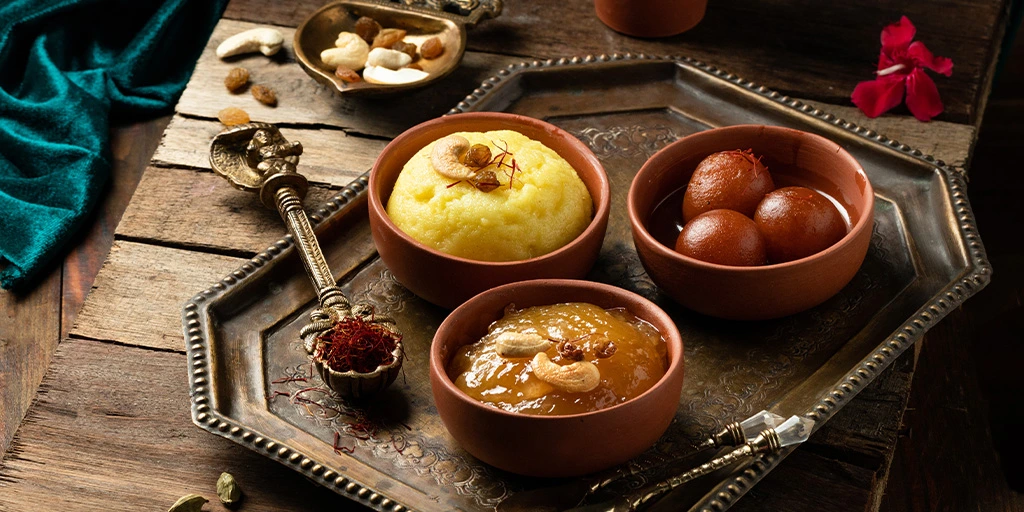
Desserts at The Madras Diaries are not just designed as an afterthought. They represent culinary memory, regional identity, and an equal attention to curation as every course. Rooted in traditions, each dessert on the menu carries a story shaped by culinary authenticity and community. In Amsterdam and Utrecht, these desserts serve a dual role: introducing non-Indian diners to foreign flavours while offering comfort and nostalgia to those who grew up with them.
This blog explores the most loved desserts at The Madras Diaries and how some of our most favoured desserts continue to resonate with guests.
Ashoka Halwa
Ashoka Halwa is a dessert defined by patience and precision. Originating from Tamil Nadu, it is traditionally prepared using wheat milk extracted through repeated washing of whole wheat flour. This process separates starch from bran, resulting in a smooth base that forms the foundation of the halwa.
The Ashoka Halwa is cooked slowly with ghee and sugar until the mixture transforms into a glossy, elastic mass. The colour develops gradually, often reaching a deep amber or burnt gold, depending on the cooking time. The halwa is finished with cashews roasted in ghee, which add structure and mild crunch.
Ingredient Profile
- Wheat milk (extracted starch)
- Sugar
- Ghee
- Cashew nuts
- Cardamom (minimal, used sparingly)
Texture and Flavour
The defining quality of Ashoka Halwa is its texture. It is neither crumbly nor sticky. Instead, it sits somewhere between firm and yielding, holding its shape while melting gently on the palate. The flavour is dominated by caramelised sugar and ghee, with wheat providing depth rather than sweetness.
Cultural Context
Ashoka Halwa is often associated with temple towns and special occasions. Its labour-intensive preparation makes it a celebratory dish rather than a daily sweet. Serving it in The Madras Diaries allows diners to experience a dessert that is rarely encountered outside South Indian homes and festivals.
Why It Is Loved
- Balanced sweetness without heaviness
- Clean, ingredient-forward flavour
- Nostalgic value for South Indian diners
- A dessert that highlights technique over decoration
Coconut Pudding
Coconut Pudding reflects coastal South India, where coconut is not an accent but a staple. Unlike Western-style puddings that rely heavily on dairy and eggs, this dessert draws its richness from coconut milk and natural thickeners.
The dessert is set to a soft, spoonable consistency. It is lightly sweetened and often finished with subtle aromatics rather than overpowering flavourings. The dish owes its taste to the authenticity and purity of coconuts.
Ingredient Profile
- Fresh coconut milk
- Coconut cream
- Sugar or jaggery (depending on batch)
- Agar-agar or natural setting agents
- Cardamom or pandan (used minimally)
Texture and Flavour
The pudding is smooth, cool, and clean on the palate. Coconut milk provides fat without density, making the dessert feel light even at the end of a full meal. The sweetness is restrained, allowing the natural nuttiness of coconut to remain central.
Cultural Context
Coconut-based desserts are common across Tamil Nadu, Kerala, and Sri Lanka, especially in regions close to the sea. These desserts evolved as practical responses to climate, using ingredients that were abundant and cooling.
Why It Is Loved
- Naturally dairy-light and easy to digest
- Familiar flavours presented in a refined form
- Suitable for guests who prefer mild desserts
- A cooling contrast to spice-forward main courses
Gulab Jamun with Ice Cream
Gulab Jamun is one of the most widely recognised Indian desserts, but its presentation at The Madras Diaries offers a deliberate contrast. Served warm with a scoop of ice cream, this pairing balances temperature, texture, and sweetness.
The gulab jamuns are prepared using traditional methods, fried slowly to ensure even cooking, then soaked in sugar syrup infused lightly with cardamom or rose. The ice cream introduces creaminess and temperature contrast without overwhelming the base dessert.
Ingredient Profile
- Milk solids (khoya or milk powder)
- Flour (minimal binding)
- Sugar syrup
- Cardamom or rose
- Vanilla or malai-style ice cream
Texture and Flavour
The jamun itself is soft and porous, absorbing syrup while retaining structure. When paired with ice cream, the dessert gains contrast. It is warm against cold and syrupy against creamy. The sweetness is moderated by the neutral dairy notes of the ice cream.
Cultural Context
While gulab jamun is not region-specific, it has become a shared dessert that is loved across India. Its inclusion reflects a bridge between familiarity and adaptation, especially for international diners.
Why It Is Loved
- Familiar dessert with a refined pairing
- Strong contrast in temperature and texture
- Appeals to both Indian and non-Indian guests
- Comforting and indulgent without complexity
Watalappan
Watalappan is a Sri Lankan dessert with deep historical and cultural roots. Often compared to caramel custard, it differs significantly in flavour and composition. Coconut milk replaces dairy, while jaggery provides sweetness and depth.
At The Madras Diaries, Watalappan is steamed slowly to achieve a firm yet silky texture. Spices are measured carefully to avoid dominance, allowing jaggery and coconut to remain central.
Ingredient Profile
- Coconut milk
- Jaggery
- Eggs
- Aromatic spices
Texture and Flavour
Watalappan is dense without being heavy. The custard holds its shape while remaining soft. Jaggery introduces bitterness and warmth, balanced by coconut milk and egg.
Cultural Context
Traditionally prepared during festivals and celebrations in Sri Lanka, Watalappan reflects colonial influences blended with local ingredients. Its presence on the menu highlights the shared culinary history of South India and Sri Lanka.
Why It Is Loved
- Complex flavour without excessive sweetness
- Custard texture with regional identity
- Appeals to diners seeking depth and warmth
- Distinct from European-style desserts
Kilakarai Thodol Halwa
Kilakarai Thodol Halwa originates from the coastal town of Kilakarai in Tamil Nadu. Known for its unique preparation method, this halwa uses wheat milk, similar to Ashoka Halwa, but differs in texture and finish.
Prepared using sea-facing climatic techniques, Thodol Halwa is stretched and folded repeatedly during cooking, resulting in a fibrous, slightly chewy texture. Ghee and sugar are cooked down slowly, allowing deep caramelisation.
Ingredient Profile
- Wheat milk
- Sugar
- Ghee
- Cashew nuts
Texture and Flavour
This halwa is more elastic than Ashoka Halwa, with visible strands when broken. The flavour is rich but not cloying, with ghee providing aroma rather than weight.
Cultural Context
Kilakarai Thodol Halwa is often prepared by specialist families and is rarely made at home due to its complexity. Its inclusion reflects The Madras Diaries’ commitment to preserving lesser-known regional desserts.
Why It Is Loved
- Rare and region-specific dessert
- Distinct texture unlike common halwas
- Strong artisanal identity
- Appeals to diners seeking authenticity
Kulfi
Kulfi represents India’s traditional approach to frozen desserts. Unlike ice cream, kulfi is dense, slow-melting, and cooked rather than churned. Milk is reduced over hours, concentrating flavour and texture.
At The Madras Diaries, kulfi is prepared using traditional reduction methods. It is flavoured subtly, allowing the cooked milk profile to remain dominant.
Ingredient Profile
- Full-fat milk
- Sugar
- Cardamom
- Pistachio or almond (optional)
Texture and Flavour
Kulfi is firm, creamy, and resistant to quick melting. The flavour is milky, slightly caramelised, and lightly spiced. Each bite feels substantial without being heavy.
Cultural Context
Kulfi is commonly associated with street vendors and summer evenings across India. Its preparation reflects a time before refrigeration, relying on reduction and freezing techniques.
Why It Is Loved
- Dense texture distinct from ice cream
- Clean, milk-forward flavour
- Nostalgic value for Indian diners
- A satisfying conclusion to a meal
Dessert Philosophy at The Madras Diaries
The dessert menu at The Madras Diaries is curated with careful attention and not expanded for variety. Each dessert serves a specific purpose: balancing spice, offering contrast and providing familiarity. The focus remains on technique, ingredient integrity, and regional accuracy.
Rather than adapting desserts to Western expectations, the kitchen preserves original flavour profiles.
Why These Desserts Resonate in Amsterdam and Utrecht
The popularity of these desserts lies in their clarity. They do not rely on novelty or presentation-driven appeal. Instead, they offer:
- Honest flavours
- Cultural context
- Ingredient transparency
- Balance after spice-forward meals
For local diners, these desserts provide discovery. For South Asian guests, they offer recognition and comfort.
Conclusion
The most loved desserts at The Madras Diaries are not defined by trend or adaptation. They are defined by restraint, memory, and technique. From the elasticity of Kilakarai Thodol Halwa to the quiet richness of Watalappan, each dessert reflects a region, a method, and a reason for its continued relevance. These desserts stand as reminders that sweetness does not need excess, and tradition does not need reinvention. It only needs care.